Showing posts with label Ellis. Show all posts

Wednesday, 27 November 2013

Sepia Saturday 205 - They are Good Sports in Surrey!


This week on Saturday Sepia I am going to go along with the sports theme.

By coincidence I had an email yesterday that talked about the Ellis family of Elstead in Surrey and several other associated names.

This morning whilst in the bathroom I recalled the first photograph I am going share here, as I thought I would share the photograph with the person who emailed me yesterday, then I spotted the theme for this week. Some things happen, by coincidence, but does it exist or is it destiny? What a deep question and all before lunch!

Elstead Football Club 1911
So here are the team, left to right

Standing Row - Herbert ELLIS, u/k, u/k, William BIAS, George WARNER, Alfred NOVELL, Guy BOVINGTON, Sandy TILSON, u/k, Henry ELLIS, Lewis NOVELL, u/k.

Sitting - first 3 u/k, Hubert HARDY, Jack BOND


Guildford Football Club 1905

Back Row - Left to Right - R.G.Harris, R. Jupp. A.Tyrell, W.G. Bridger, A.J.May, S.W. Turner, L.Green

Front Row - Left to Right - A. Groves, M.Avery. L.C. Ede, F.Luck (captain), C Ellis, W. Rossiter, Alb Giles


Wanborough Cricket Team - circa 1920
Sadly no one from this photograph of a Wanborough cricket team can be identified - I date this about 1930.

Friday, 15 November 2013

Remembrance Day Photo Collage - Day Twelve

This is the document that relates to Edward Ellis, born in Geelong Victoria Australia the son of Frederick Ellis (1845 - 1914) and Sarah Ann Newton (1851 - 1923) on 3rd March 1882 and was one of 14 children.  All of Edward's siblings were born in Australia, but his father, Frederick had been born in Elstead Surrey in 1846 and was 8 years old when his parents migrated as free settlers to Geelong in 1854 on board the James Baines.


As I typed the above I realised that I really didn't know too much about Edward and my family history software had not been updated, so I pulled out the Ellis folder. Back in 1991, I had located various bits of information about Edward and here are those details:
  • Born at Mount Duneed 3rd March 1882 and Baptised at the Wesleyan Church in Geelong 6 June 1884.
  • A tuber player in Geelong Harbour Trust Band circa 1913.
  • He enlisted at Cootamundra, New South Wales on 20th July 1916 and left Australia on 9th November 1916 on board The Benalla. (Service number 2804)
  • He disembarked in Devonport (Plymouth Devon England) on 9th January 1917.
  • He proceeded to France on 30th September 1917 and was wounded in action (left leg) at Rouelles in August 1918. 
  • He was discharged in England in January 1919 and returned to Australia on board The Karoa.
Having read the above in the file some obvious questions sprang to mind:

Questions:
  1. What was the significance of the Wesleyan Church? Why not a C of E Church?
  2. What further details could I establish about the Harbour Trust Band
  3. Why did he enlist in Cootamundra? It is some distance from Geelong, but is mainly farming territory. Ironically, I have been to both Geelong and Cootamundra!I spent about a week in Geelong last year and visited the various graves at Mount Duneed.
  4. He was disembarked in Devonport, only about an hour from here in the car. What other records exist in the UK?
  5. Locate Rouelles in France
  6. Did he know of or remember his English heritage and roots? Did he venture to Surrey to meet any of the family?
  7. Where did his life take him upon his return to Australia? 

Thursday, 14 November 2013

Sepia Saturday - 203

For this week's visionary prompt of standing in doorways, I thought I would share this image


The picture is of my Great, Great Grandparents Henry Harris (1843-1929) and Caroline Harris nee Ellis (1844 -1935). This photograph was taken on the occasion of their 60th Wedding Anniversary in 1924 and was taken at Wanborough Surrey. 

The photographer was my late Great Aunt, Rose Marshall nee Butcher (1900 - 1994). Caroline was apparently a bit of a stickler and though nothing of smacking her Grandchildren if they misbehaved, whilst Henry was a "sweet old thing" according to my Aunt. I asked if she could recall an example. This is from my journal what she told me back in 1990 -

 "Old Sam Marshall came across to tell Mum (Annie Prudence Butcher nee Harris) that the Boys (Dick, George (my Grandfather), Arthur & Harry) had been scrumping again from the apple tree."

When I asked what happened to the boys - 

"The boys came home, all sweetness and light and Mum asked where they had been? They were vague and said the fields. When Mum asked if they had been over to Sam Marshall's they said they might have been. Mum, was not deterred. I wish you boys wouldn't. Do it again and you will get what for. What did you do with the apples? Oh we ate them was the reply, then one of the boys said, why do you want us to get you some? I don't recall which of them said that, but they were all sent outside. Later they came in for tea and Harry said he was sore, when Mum asked why he said Granny. Old Grandpa was listening in, he shook his head and said but those apples are nice, aren't they?"

The background is the Sam Marshall was a local farmer, and was in fact related to Caroline through marriage. Her sister Maryanne married Jim Marshall, the added complication was that the Marshall family were already connected to the family prior to that marriage and things were further complicated when in 1931 Rose married Maryanne's Grandson Ernest.  Something that Caroline disapproved of and my Aunt always vehemently denied.

Taking part in Sepia Saturday


Sunday, 10 November 2013

Remembrance Day Photo Collage - Day Seven

This photograph was taken on a really grey and miserable autumn day about 20 years ago.

It is the War Memorial at Elstead in Surrey, about 2 miles from Puttenham where the majority of my Great Grandmother's family hailed from.

My Great Great Grandmother was called Caroline Ellis. Born in Puttenham in 1844 the daughter of George and Prudence Budd.

My Grandfather's cousin always maintained the Elstead got it's name from the multiple Ellis families in the area, Ellis-Stead. How much of that is true I don't know, except there were multiple Ellis families and unravelling them is a genealogist nightmare. The same names keep appearing; so I have three George and Sarah Ellis' giving birth to children, with the same names around the same time. Nightmare to research!

The Ellis' on this memorial are in fact cousins of Caroline Ellis. I do have photographs of those named, but have elected to share them a little later on a project I have planned for 2014. However, this memorial is in fact incomplete. There was at least one more Ellis that gave his life and he is not named on the memorial.

I became aware of Amos Ellis a few weeks ago when I received an email from someone. I had up until this point not been aware of Amos, because he was not a direct ancestor. I felt so sad that someone can contribute so much and yet simply slip through the cracks.

So today, as I post late on Sunday and we roll across into Armistice Day it seems fitting to mention Amos and be aware that there are instances like this across the Country. Do we not owe it to these men and their descendants to put the matter right?

Saturday, 9 November 2013

Remembrance Day Photo Collage - Day Six

This post is about my 4th Great Grandfather George Ellis. He has lead me on quite a journey!

George Ellis was baptised on 12 June 1774 at Holy Trinity Church in Guildford Surrey, the son of James Ellis and Elizabeth Bridger.

George is located as an apprentice, which confirms that George at the age of 17 years, was apprenticed to Richard Fludder, a blacksmith of Puttenham for a period of 4 years, to learn the trade for his keep and a wage of 2/- weekly for the first year, 2/6 for second year, 3/- for third year and 3/6 for the remainder, but he was turned away without notice after 3 and a half years. 

We can therefore estimate the time he was apprenticed was from 1791 - 1794 or 1795. We know he joined the military in 1797, and that he was married to an unknown wife pre 1805 because when he marries Sarah Beagel in 1805, he is classed as a widower. 
Marriage to George's second wife -
Sarah Beagel 1805. St Mary's Guildford
Marriage to George's third wife  -
Sarah Virgo in 1824 at Holy Trinity Guildford,
who signed her name as Mary Virgo!

George Ellis left the employ of the 10th Hussars having served 20 years and 48 days and was discharged at Brighton Sussex.

Statement of Service  - 10th Royal Hussars,  March 1797 - May 1817
The National Archives WO97/45/38
Discharged in 1817 after serving 20 years and three months, injuries of
Stricture of Urethra, subject to fits and severe injury of the shoulder
The National Archives WO97/45/38
George is named on the Peninsular Medal Roll as receiving 4 clasps with the following particulars:
S & B = Sahagan & Benevente
V = Vittoria
O = Orthes
T= Toulouse
This looks like where George sustained the injuries that lead to his discharge three years later.

In the early part of 2010 I was searching The National Archives site and came across a reference to George Ellis, late of the 10th Light Dragoons in relation to a pension. When the document arrived I looked and for whatever reason didn't spot that although this document relates to someone else there is an insert in relation to George. Here is the full document.

Full document from the National Archives
with the insert relating to George Ellis 1819
The National Archives WO121/182/42
Insert relating to George Ellis.
Who still had not received monies from
the war pension in 1819.
The National Archives WO121/182/42
A further search at the National Archives revealed another reference
  1. WO121/182/42 (see film 134) - Records of Royal Hospital Chelsea - Certificates of service and related correspondence - with a mention of 11th Royal Veteran Battalion (see above)
  2. WO97/1184B/320 - Records of Royal Hospital Chelsea  - Miscellaneous - Served 11th Royal Veteran Battalion
An example of the dress worn by those in the 10th Royal Hussars

After George's discharge he returned to Puttenham, and I have a hunch that there is more unraveling and unearthing of documents to do; I have no proof that I can find anything more about him, other than a hunch, which I plan to explore.

Whatever he did, to fall out of favour with Richard Fludder before he joined the military is a mystery. On his death certificate he is recorded as being a blacksmith and the cause of death is "Exhausted Nature"

Death Certificate for George Ellis 1850.

Wednesday, 6 November 2013

Remembrance Day Photo Collage - Day Three

William Arthur West was born in 1863 in Guildford. I became aware of him through the his marriage to my Grandfather's Aunt - Emma Jane Ellis (Harris). They married in 1897 and raised two children. A son called William James born 1898 in Aldershot Hampshire and a daughter, Clara Edith born 1901 in Aldershot. I commemorated William James in yesterday's post.

I knew from my Grandfather's cousin that William Arthur had been a military man and made an earlier assumption, at this point I had not researched his military life, that he had been in the Boer War. I was then presented with some photos:

Medical Corp during Boer War

William Arthur is the second from the right in the back row.

This photo was taken during the Boer War. William was already in the Army, serving in the Medical Corp by the time of the Boer War. He joined in 1878 and spent time abroad during the Zulu Wars and the Afghan Wars. His wife accompanied him and died in Zululand in 1894 and her death certificate is below. He remarried to his Cousin in 1897 and they subsequently had two children, as I mentioned above.

I love the sign "Den of Terror"!

By chance I did a Google search on William Arthur. I have never come across anyone researching this family outside of my immediate family so what happened to William and Clara. I also wanted to know more of William Senior. I did know that after leaving the military he owned a sweet shop in Stony Stratford, Buckinghamshire.

The Google search revealed an interesting website article, although a recent search does not show the article, which is a great shame. Anyway, the article looked at my William Arthur West from the perspective of the community in which he lived, Stony Stratford. The article provided a few clues which I had not been aware of, and I used this as a springboard for further research and to fill in a few gaps into William's earlier life.

Josephine West Death Certificate

I had already been in contact with the author of the article. I had a reply and was delighted to hear that they had quite an archive of material relating to my ancestor. I was invited to come and look at the article. I replied that given the distance it would not be until our next trip north of here and I was really surprised when I was offered the opportunity to receive the archive in the post for my perusal and copying. In due course the file arrived and I managed to copy the entire archive and return with some extra material by tracked post. That is one of the things that I love about genealogy, it is the genuineness of fellow researchers.

Tuesday, 5 November 2013

Remembrance Day Photo Collage - Day Two


William James West was born in Aldershot Hampshire in 1898, the son of William Arthur West, a military man and, Emma Jane Ellis (Harris).

I had always known that my Grandfather's first cousin had died in the First World War, and then I was presented with a photograph of William, such a handsome young man! The moment I saw that photograph I wanted to know all I could about William.

Private William James West served with the 1st Battalion Cheshire Regiment. He is Commemorated at: Ligny-Sur-Canche British Cemetery, Pas de Calais, France. He died of wounds on 5th September 1918, aged just 20 years.

He is commemorated on the War Memorial at Stony Stratford Buckinghamshire, where his parents, William Arthur and Emma Jane West lived & ran their newsagents business at 63 High Street.

I submitted the details for William James to the First World War Digital Archive whilst material could be submitted. As I wanted to further preserve the details of William.

William James had two army numbers and was Private T4/212898 William James West, Army Service Corps, and later was 51275, 1st Bn. Cheshire Regiment. His T4 Army Service Corps prefix indicates he once served in transport.

As I said I submitted his details to the Digital Archive and they further spotted a detail I had not known about the photograph, as he is rather oddly, pictured above wearing a 'lamb and flag' cap badge, relevant to neither unit he was known to have served in, (unless he served for a time in the small Army Service Corps Armoured Car Companies, recruited from transport personnel. Their 'Light Armoured Motor Batteries', operative in Palestine, wore a similar badge unofficially).


Bombing during the Second World War destroyed some of the records from the First World War.

I was lucky, in that William James's record survived and is a total of 24 pages detailing when he enlisted, his service and which regiment he was attached to and then, finally his gun shot wound to the chest leading to his death in 1918, just months before the war ended.

I have downloaded a copy of his Service Record and have just noticed a mention of the Devonshire Regiment that I had been unaware of.

His medal card, confirms what medals his family were entitled to claim after his death and this corresponds with the Service Record.

May he rest in peace and know that even though he paid the ultimate sacrifice he is still firmly in the heart of his family.

Monday, 24 June 2013

Mystery Monday - Harris in Headley Hampshire


Background 

Caroline Ellis, shown here on the left, was born in Puttenham Surrey in 1844 the daughter of George Ellis, a former military man and Prudence Budd. The Budd family had been established in the parish of Puttenham since 1723, and lack of surviving records has prevented a firm conclusion of the Budd's originally living in nearby Shackleford. Together, Caroline and Henry raised a family of ten children, all born in Puttenham. Caroline and Henry spent 65 years together, with Henry passing away in 1929 and Caroline in 1935.

Henry Harris was born in Headley Hampshire in 1844 to George Harris and Harriet EARLE. Henry was one of not only 10 children born to George and Harriet, but also one of set of triplets. George and Harriet had previously had twin boys, George and John in 1837, John though, died aged 1 year. In 1844 when Henry was born, his mother also gave birth to Emma and Thomas. Henry and Emma both lived into adulthood, although Emma died in her late 30s and sadly, Thomas died aged just one year. Henry lived until 1929 when he passed away aged 86 years. Were multiple, multiple births common in the 19th Century? Henry worked as a labourer and around 1864 married Caroline Ellis in Puttenham Surrey.

This photograph, taken by their Grand daughter, my Great Aunt on the occasion of their 60th Wedding Anniversary.

It was the tale relayed to me by the same Great Aunt who took this photograph that has provided the minuscule details of my Monday Mystery.

Monday Mystery

My Aunt said that her "Granddad Henry had been "swizzled" out of some land on the Common (Puttenham or Headley) by his niece Jane Harris. He even went to London to try and get it back, but he didn't manage it"

I have always been curious over this matter and not long after I started researching my ancestry I met a family member, connected to the Harris & Burrows line. There had certainly been a feud, although if this was the cause of it I can not say.

In the meantime, the local archives for Headley have transcribed the records and notebooks left by the vicar of the parish. Within those notebooks is the following -

"p.281 Letter:4 Field Court, Gray’s Inn, W.C.,
Telephone 2525
Telegraphic Address: “HUNTSMOOR, LONDON”
20 April 1888
Dear Sir
You may have heard from Mr WRIGHT that we have been obliged after all to abandon the claim by Daniel HARRIS to the fund in the Court of Chancery.
We find that Letters of Administration were taken out to the missing Legatee’s Estate many years ago by Henry HARRIS who described himself as the cousin of the missing legatee. If this were correct that is to say, if the missing legatee’s father was legitimate, David HARRIS’ share would be a few pounds only and to prove that it is incorrect requires an action in the Probate Court which would exhaust the whole of the fund.
We beg to thank you for the assistance you have so kindly given us in the matter.
We are, Dear Sir,
Yours faithfully,
R S Sayle & Son & Humphreys
To: The Rev W H Laverty
Headley Rectory
Liphook
Hants."

This does not appear to be the same story as the one my late Aunt said, so is this somthing different?

The names of David and Daniel Harris do appear within my family, both brothers of Henry's father. There was also a Daniel Harris who married a Charlotte Bridger who connects with my late Grandmother's family.

Such a lot of mystery to unravel and that is before I even start on the Harris families!

This map does given and idea of the complexities of the geography of this area, which explains the various families marrying into other families that already sit within my genealogy. Really, it is no wonder I have a genealogical headache hangover!

Photograph of a map presented in A Souvenir  of Headley By
Charles H Beck 1896

Wednesday, 28 March 2012

Carnival Of Genealogy 116 - Picture/Story for Women's History Month.

This pretty young woman is my Great Great Aunt, Emma Jane Harris, although she was born to her parents just before they married!

Emma Jane was born on the 1st November 1864 in Puttenham Surrey the daughter of Henry Harris and Caroline Ellis who were to marry on 3rd December 1864 and raise together a family of 10 children.

Emma married her cousin, William Arthur West in 1897. William was a soldier who had seen service in the Zulu Wars in which he had lost his first wife and young babe.
So I can imagine the emotions felt by both Emma and William as they married.

They were blessed with two children, a son, William James born in the military town of Aldershot in 1898 and Clara in 1901.

By the time of the First World War, William Arthur had left the services and had set up a newsagents business in Stony Stratford on the Buckinghamshire and Oxfordshire Borders. His son William James though, followed in his father's footsteps and joined the Army. I am sure that both his parents were proud of their son and the contribution he was to make. We know that prior to his departure to France he had his portrait taken and his mother treasured it. As it appears as a pendent in the following photograph.


Sad to say that amongst that proud parental feeling was deep sadness, as their only son paid the ultimate sacrifice. This is such a sad photograph, and Emma has such a haunted look. I simply wish I could move into the photograph and give her such a hug, but alas that is not to be.


It seems completely correct that I end this post with a photograph of Emma's only son, who died, aged just 20 years, only two months before the end of the First World War.


Carnival of Genealogy is hosted by Jasia at CreativeGene

Friday, 9 March 2012

Sepia Saturday 116 - Hair

This week I am featuring some of my Ellis ancestors - they had a thing about hair!

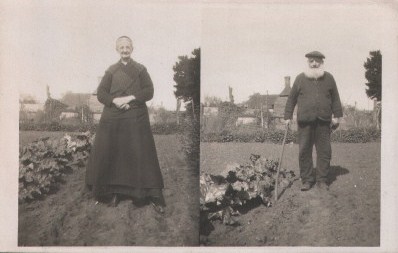
First up is Job and Lucy Ellis. They lived in the rural village of Elstead Surrey. Job was born in 1848, married Lucy in 1868 and he passed away, aged 89 years in 1937. I love the big bushy beard.

Meet John Ellis


John Ellis was an Uncle to Job. He was born in Elstead in 1817. He married Sarah Turpin in 1842. Sarah worked at Elstead Mill as a lace maker. In 1854, John and Sarah migrated to Geelong Victoria Australia where they had another 4 children. John died, aged 83 years in 1900.


Taking part in Sepia Saturday

Thursday, 10 November 2011

In Remembrance of William James West (1898 - 1918)


In Remembrance of William James West

William James West was born in Aldershot Hampshire in 1898, the son of William Arthur West, a military man and, Emma Jane Ellis (Harris).

I had always known that my Grandfather's first cousin had died in the First World War, and then I was presented with a photograph of William, such a handsome young man! The moment I saw that photograph I wanted to know all I could about William.

Private William James West served with the 1st Battalion Cheshire Regiment. He is Commemorated at: Ligny-Sur-Canche British Cemetery, Pas de Calais, France. He died of wounds on 5th September 1918, aged just 20 years.

He is commemorated on the War Memorial at Stony Stratford Buckinghamshire, where his parents, William Arthur and Emma Jane West lived & ran their newsagents business at 63 High Street.

I submitted the details for William James to the First World War Digital Archive whilst material could be submitted. As I wanted to further preserve the details of William.

William James had two army numbers and was Private T4/212898 William James West, Army Service Corps, and later was 51275, 1st Bn. Cheshire Regiment. His T4 Army Service Corps prefix indicates he once served in transport.

As I said I submitted his details to the Digital Archive and they further spotted a detail I had not known about the photograph, as he is rather oddly, pictured above wearing a 'lamb and flag' cap badge, relevant to neither unit he was known to have served in, (unless he served for a time in the small Army Service Corps Armoured Car Companies, recruited from transport personnel. Their 'Light Armoured Motor Batteries', operative in Palestine, wore a similar badge unofficially).


Bombing during the Second World War destroyed some of the records from the First World War.

I was lucky, in that William James's record survived and is a total of 24 pages detailing when he enlisted, his service and which regiment he was attached to and then, finally his gun shot wound to the chest leading to his death in 1918, just months before the war ended.

I have downloaded a copy of his Service Record and have just noticed a mention of the Devonshire Regiment that I had been unaware of.

His medal card, confirms what medals his family were entitled to claim after his death and this corresponds with the Service Record.

May he rest in peace and know that even though he paid the ultimate sacrifice he is still firmly in the heart of his family.

Saturday, 14 May 2011

Ancestor of the week - George Ellis - Part Two - Military Life

It seems fitting today to post the second part of Ancestor of the week in relation to George Ellis.

194 years ago today, my Great, Great Great Grandfather, George Ellis left the employ of the 10th Hussars having served 20 years and 48 days and was discharged at Brighton Sussex.

Statement of Service  - 10th Royal Hussars,  March 1797 - May 1817
The National Archives WO97/45/38
Discharged in 1817 after serving 20 years and three months, injuries of
Stricture of Urethra, subject to fits and severe injury of the shoulder
The National Archives WO97/45/38
George is named on the Peninsular Medal Roll as receiving 4 clasps with the following particulars:
S & B = Sahagan & Benevente
V = Vittoria
O = Orthes
T= Toulouse
This looks like where George sustained the injuries that lead to his discharge three years later.

In the early part of 2010 I was searching The National Archives site and came across a reference to George Ellis, late of the 10th Light Dragoons in relation to a pension. When the document arrived I looked and for whatever reason didn't spot that although this document relates to someone else there is an insert in relation to George. Here is the full document.

Full document from the National Archives with the insert relating to George Ellis 1819
The National Archives WO121/182/42
Insert relating to George Ellis. Who still had not received monies from
the war pension in 1819.
The National Archives WO121/182/42
A further search at the National Archives revealed another reference
  1. WO121/182/42 (see film 134) - Records of Royal Hospital Chelsea - Certificates of service and related correspondence - with a mention of 11th Royal Veteran Battalion (see above)
  2. WO97/1184B/320 - Records of Royal Hospital Chelsea  - Miscellaneous - Served 11th Royal Veteran Battalion
An example of the dress worn by those in the 10th Royal Hussars

Monday, 9 May 2011

Ancestor of the week - George Ellis - Part One - Domestic Life

This is the belated Ancestor the week post from 12th March 2011 and is about my 4th times Great Grandfather George Ellis. He has lead me on quite a journey, which is why the post is so late in being cast out to the ether.

About two months ago I received via Genes Reunited a message from a fellow researcher. We corresponded and confirmed that we were indeed connected to the same family. It then became clear to both of us that some of the data, collated 20 years ago was incorrect. My whole world stopped. How incorrect? I was right, I had the correct individual, and the details of his marriages, well two of them anyway, and of this son, my direct line of descent. What was incorrect was the birth place of his other children. I revisited my original notes and for reasons which are unclear, I have indeed made a mistake, thankfully, it can be rectified and hasn't caused too much disruption. 

George Ellis was baptised on 12 June 1774 at Holy Trinity Church in Guildford Surrey, the son of James Ellis and Elizabeth Bridger.

George is located as an apprentice, which confirms that George at the age of 17 years, was apprenticed to Richard Fludder, a blacksmith of Puttenham for a period of 4 years, to learn the trade for his keep and a wage of 2/- weekly for the first year, 2/6 for second year, 3/- for third year and 3/6 for the remainder, but he was turned away without notice after 3 and a half years. 

We can therefore estimate the time he was apprenticed was from 1791 - 1794 or 1795. We know he joined the military in 1797, and that he was married to an unknown wife pre 1805 because when he marries Sarah Beagel in 1805, he is classed as a widower. 
Marriage to George's second wife - Sarah Beagel 1805. St Mary's Guildford
Marriage to George's third wife  - Sarah Virgo in 1824 at Holy Trinity Guildford,
who signed her name as Mary Virgo!
Death Certificate for George Ellis 1850.
There is still much to discover about George, and as I uncover further details I suspect that another Ancestor of the week post will be waiting in the wings........

Sunday, 24 April 2011

Trans Tasman ANZAC Blog Challenge

In keeping with Australia Day inspired by Twigs-of -Yore and the subsequent post for Waitangi Day.

We now have the Trans Tasman ANZAC Blog Challenge. Below are the details from the Auckland Reseach Centre Facebook page

"To participate:
*Write a blog post about an Australian or New Zealander serviceman or woman’s family, and the impact war had on their family history.
*Publish your post by 25 April 2011
*Post a comment with the URL on the Auckland Research Centre’s Facebook page under discussion or on the relevant post on the Twigs of Yore blog."


This is the document that relates to Edward Ellis, born in Geelong Victoria Australia the son of Frederick Ellis (1845 - 1914) and Sarah Ann Newton (1851 - 1923) on 3rd March 1882 and was one of 14 children.  All of Edward's siblings were born in Australia, but his father, Frederick had been born in Elstead Surrey in 1846 and was 8 years old when his parents migrated as free settlers to Geelong in 1854 on board the James Baines.


As I typed the above I realised that I really didn't know too much about Edward and my family history software had not been updated, so I pulled out the Ellis folder. Back in 1991, I had located various bits of information about Edward and here are those details:


  • Born at Mount Duneed 3rd March 1882 and Baptised at the Wesleyan Church in Geelong 6 June 1884.
  • A tuber player in Geelong Harbour Trust Band circa 1913.
  • He enlisted at Cootamundra, New South Wales on 20th July 1916 and left Australia on 9th November 1916 on board The Benalla. 
  • He disembarked in Devonport (Plymouth Devon England) on 9th January 1917.
  • He proceeded to France on 30th September 1917 and was wounded in action (left leg) at Rouelles in August 1918. 
  • He was discharged in England in January 1919 and returned to Australia on board The Karoa.
Having read the above in the file some obvious questions sprang to mind:

Questions:
  1. What was the significance of the Wesleyan Church? Why not a C of E Church?
  2. What further details could I establish about the Harbour Trust Band
  3. Why did he enlist in Cootamundra? It is some distance from Geelong, but is mainly farming territory.  Ironically I have been to both Geelong and Cootamundra!
  4. He was disembarked in Devonport, only about an hour from here in the car. What other records exist in the UK?
  5. Locate Rouelles in France
  6. Did he know of his English heritage and roots and did he venture to Surrey to meet any of the family?
  7. Where did his life take him upon his return to Australia? 

Tuesday, 5 April 2011

Blogging A-Z - April Challenge - D is for.....

D is for......Discovery

We start the path to discovery as a young baby, crawling, walking, talking and touching.  As we progress along the path life leads us, we continue that road of discovery. This posting is about my journey and the discoveries made at the end of the path.

I guess one of the biggest discoveries I have made is reading. With each book, from chick-lit to novel to historical or professional text they are all read and somewhere along the way there is a discovery.

My genealogical studies and research routinely yield a discovery. This is a recent one. The Military Service record for my Great Great Great Grandfather, George Ellis. George served in the 10th Light Dragoons or Hussars from 1797 - 1817. The discovery is not the record, although that is wonderful to see and I marvel that it has survived, it is the signature and the physical description of George that I think is a wonderful discovery.


Professionally I have continuing professional development, which is not only a professional requirement as a code of practice, but also a way of discovery.  I was talking to a professional colleague recently, who announced that their recent discovery was they did not like doing the day job. They had just realised it, some 15 years after qualifying.

The expression of learning something new every day is very accurate and each of those new things is a discovery to be enjoyed.

Sunday, 6 March 2011

Ancestor of the week - Willliam James West


This is the belated post from 26 February.

William James West was born in Aldershot Hampshire in 1898, the son of William Arthur West, a military man and, Emma Jane Ellis (Harris).

I had always known that my Grandfather's first cousin had died in the First World War, and then I was presented with a photograph of William, such a handsome young man! The moment I saw that photograph I wanted to know all I could about William.

Private William James West served with the 1st Battalion Cheshire Regiment. He is Commemorated at: Ligny-Sur-Canche British Cemetery, Pas de Calais, France. He died of wounds on 5th September 1918, aged just 20 years.

He is commemorated on the War Memorial at Stony Stratford Buckinghamshire, where his parents, William Arthur and Emma Jane West lived & ran their newsagents business at 63 High Street.

I submitted the details for William James to the First World War Digital Archive whilst material could be submitted. As I wanted to further preserve the details of William.

William James had two army numbers and was Private T4/212898 William James West, Army Service Corps, and later was 51275, 1st Bn. Cheshire Regiment. His T4 Army Service Corps prefix indicates he once served in transport.

As I said I submitted his details to the Digital Archive and they further spotted a detail I had not known about the photograph, as he is rather oddly, pictured above wearing a 'lamb and flag' cap badge, relevant to neither unit he was known to have served in, (unless he served for a time in the small Army Service Corps Armoured Car Companies, recruited from transport personnel. Their 'Light Armoured Motor Batteries', operative in Palestine, wore a similar badge unofficially).


Bombing during the Second World War destroyed some of the records from the First World War.

I was lucky, in that William James's record survived and is a total of 24 pages detailing when he enlisted, his service and which regiment he was attached to and then, finally his gun shot wound to the chest leading to his death in 1918, just months before the war ended.

I have downloaded a copy of his Service Record and have just noticed a mention of the Devonshire Regiment that I had been unaware of.

His medal card, confirms what medals his family were entitled to claim after his death and this corresponds with the Service Record.

Thursday, 3 March 2011

Carnival Of Genealogy 103: Female Genealogy

As modern women I believe we truly under estimate the hardship, suffering and resilience of our female ancestors. Let us consider what we have that they often did not.
  • Electricity and Gas, forms of heating and light
  • A benefit system that could be used if the need arose, without fear of stigma
  • Running water that was safe to drink
  • Accessibility to medicines that worked
  • Security from unscrupulous employers, landlords and retailers
  • A World where child mortality is low
  • Being able to wash ourselves,clothes and dishes without have to visit the well first.
  • Women's rights - we are able to vote, to own property and to be our own person
  • ......the list is endless.
How would we cope if we had to work 15 hours a day for a meagre wage? Yet our ancestors did and they, in some form or other survived otherwise we would not be here today. Women are often the backbone of the family, not from necessarily a financial aspect, although, in rural 18th and 19th Century England women would have worked in the fields too, and the children. Women tended to the men folk, looked after elderly relatives in a domestic sense, looked after the children and tended to the homes and organised the food requirements, making the money goes as far as it could. I believe that we underestimate the female ancestors we each have and perhaps judge them in comparison to modern standards.

What though, if you had been born into the middle and upper classes? You grew up being unable to provide for yourself in a domestic and financial manner. If we want a cup of tea we switch the kettle on and make it. In the 18th Century, depending on your financial standing you either rang a bell and someone made you the drink of your choice or you went to the well and obtained the water, perhaps carrying it and any young babes several miles, poured water into a pan of some kind and boiled it over a fire. Could you even afford tea?

As I have researched my own ancestry, I have developed an attachment to some of my ancestors, their contribution to my ancestry is, in some cases overwhelming. The first is Esther Bellasis, who has been the resent subject of an earlier post, and I will not reiterate that here in its entirety, except to say that Esther made a contribution to history that she herself probably never even considered.

Esther was born Ester King in 1770, the daughter of John King and Mary nee Budd. The whole story resembles that of Pride and Prejudice as John and Mary had a family of 10 children, 9 of whom were girls,and nearly all of them involved with the Honourable East India Company in some way. Esther married George Bridges Bellasis in 1796 in Calcutta India. George was known as the most "Handsome man in India" a fact gleaned from the book written about the Bellasis family called "An Honourable Company" by Margaret Bellasis published in 1952.

What has been established is that the girls went out to India in installments, as they became of age and they were dispatched to parts of the "Empire" in the care of the elder sisters. The story is that one of Esther's sisters was proposed to. The proposal was later retracted and a dual between the proposer and George Bridges Bellasis ensued. As a result George Bridges Bellasis was sent to Botany Bay for life for killing the proposer, having been transported on board the ship called "The Fly" in 1802. When he arrived in Sydney, George was immediately given a conditional pardon by Governor King and on 24 June 1803 received a Royal pardon as an "act of commiseration towards a gallant, but unfortunate officer and an afflicted dying wife".

I wondered about Ester. Just what had her life been like? Married to a well to do member of the HEIC, was she shamed because of the dual and subsequent outcome of that?, then transported like a common criminal? I wish I knew just what she thought and felt. I wondered just what research material had been left behind of the Bellasis time in Australia. George it is well documented as a military man in Australia and India, there is evidence that he was involved in the Freemason movement in the early days of the colony.

I did a search online for "Mrs Bellasis"+Australia and for variations of - Botany Bay, Ester Bellasis and was very surprised to find this painting.
I sent off to the archive, The Mitchell Library, State Library for New South Wales, for a electronic copy and it is one of my genealogical treasures. What is especially wonderful is that the painting by Ester Bellasis is the earliest known piece of artwork by a woman in Australia, so it looks like Ester made her mark after all, which I find delightful, and this is what I meant when I said her contribution to history.

George and Ester returned to England in the early 1800s and Ester is commemorated at Puttenham Church having died in 1805 in Berkshire, at the Bellasis home. George returned to India and later remarried, to his deceased wife's sister, Elizabeth Kent nee King, herself a widow. George died in India in 1825 and the sister Elizabeth in Kent in 1837.

There is just something about that picture that I find soothing. Perhaps it is the fact that Esther was in some small way a women in her own right, in a small way an artist, a contribution to history that she would probably have never realised at the time. Did she get on the boat back to England and realise that the painting had been left behind, or did she intend to leave it far from home? We shall never know.

Do though, some of the characteristics and skills of our ancestors live on in us, two, three or even ten generations later?


This is a photograph of one of my Maternal Great Grandmothers, Caroline Ellis nee Harris 1844 - 1935 with four of her daughters. My Great Grandmother, Annie Prudence Butcher nee Harris is the lady on the far left. Caroline was in her early 90s when she died, as was my Great Grandmother, and that tradition was followed by three of Annie's five daughters. Yes, people are living longer, but is that the only reason for longevity? Isn't there a chance that genetics, passed from one generation to another simply continue, as do expressions, gestures and a hosts of other things that we inherit from our relatives.

When I look at this photograph, which I was given, from the daughter of the lady second on the left, who also died in her mid 90s, I am struck by the time line of history. When Caroline was born Queen Victoria had been on the throne for 7 years, and when she died we were just 4 years away from the Second World War. For me that is a perspective. The changes that Caroline had experienced are remarkable and I can't help but wonder just what she would make of the 21st Century, with our lives of internet shopping and communication via the internet and telephone, What would she make of an iphone or an ipad for example. So much development in what is historically speaking a short space of time.

I hope, that my ancestors would be as proud of me, as I am of them and the contribution they made to my ancestry.

Linkwithin

Related Posts Plugin for WordPress, Blogger...