Showing posts with label Channel Islands - Jersey & Guernsey. Show all posts

Thursday, 19 July 2012

Guest Post - Gillian Mawson

I have recently had the good fortune to interview Gillian Mawson, author of the forthcoming book, Guernsey Evacuees. This is a fascinating subject and I am delighted that Gillian agreed to be interviewed. Here is what Gillian had to say -

What was it that inspired you to research the topic of Guernsey Evacuees?

In early 2008 I was researching the Manchester Blitz of December 1940, when I discovered a June 1940 newspaper which described the arrival of thousands of Guernsey evacuees in England. 2,000 of them arrived in my home town of Stockport, Cheshire and I knew nothing at all about these evacuees. I tried to find out more but could discover very little, and I realised that this was an untold story of the Second World War Home Front which needed to be captured. This prompted me to trace surviving evacuees, when I discovered that many had not returned to Guernsey after the war, but had remained in England. As I began my interviews in England and in Guernsey, I was gripped by these previously untold stories and, due to the advanced age of the evacuees, I decided to record as many stories as I could before it was too late. I left my full time job as a university administrator/researcher to pursue this Guernsey research more fully, and I have now interviewed almost 200 evacuees.

At what point did you realise that your research could become a book?

Between 2008 and 2010 I began to put together the various pieces of the Guernsey evacuation story and it was similar to putting together the pieces of a jigsaw puzzle. I realised quite early on that these emotional and untold stories would make a great book, but I was intent on continuing to collect as many personal stories as possible. Last year I was delighted to be approached by the History Press who asked me to write a book for them. I chose to write a book aimed at the general public rather than to write an academic book. I want to bring out the very human element of these evacuee experiences – the joy, the sadness, the family separation, the courage and determination, and the bonds that were formed between many of the evacuees and their neighbours in England. Many of these bonds continue today.

What was the most surprising thing you learnt from your research?

Guernsey evacuees arriving in
Cheshire, Summer 1940
I was surprised by the way that these evacuee experiences gripped me, due to the emotional issues contained in each unique evacuee's story. The research practically took over my life. I was not only drawn into the history of the island of Guernsey, but also drawn in to the story of the English Second World War Home Front in a way that I had not previously been. Five thousand school children were evacuated from Guernsey with their teachers and some of these schools were re-established in England for the duration of the war.  Thousands of Guernsey mothers left home with their infants in their arms and little else, and created new lives for themselves in England. In addition, the Guernsey evacuees' contribution to the British war effort during the Second World War was amazing! 

I have formed friendships with many of the evacuees I have interviewed. I attended an evacuee reunion in Guernsey in May 2010, and in June 2010 I organised an evacuee reunion in England which was attended by evacuees, their friends and many local people. After this event I set up a community group for the evacuees who remained in northern England after the war, to enable them to share their wartime experiences with the local community. I also produced a short documentary film about 'Guernsey Evacuees in Lancashire, England', with my colleagues from Bury Archive Service. I sell copies of the DVD via my website to raise funds for our evacuee community group.

We also speak to school children and museum audiences to bring home the story of the Guernsey evacuation, and this brings the younger and older generations together in a unique way. I also organise 'Guernsey evacuation' events in museums and galleries. 300 people attended our event in Stockport in October last year, which was filmed by the BBC. You can watch an online clip of the event at http://www.bbc.co.uk/news/world-europe-guernsey-15536660

How easy was it to conduct the research & interviews?

I prefer to interview evacuees in person, but I sometimes have to conduct interviews over the telephone as I cannot always afford to travel to their homes. I have travelled around England interviewing evacuees who did not return to Guernsey after the war.

I have visited Guernsey six times and spent most of that time interviewing people. A typical day includes interviewing an evacuee in the morning, another at lunch time, another in the afternoon and sometimes one more in the evening! The cost of travelling from England to Guernsey is prohibitive, so I have to do as much as I can each time I make the journey. I also try to squeeze in a trip to a Guernsey archive during these visits. Sadly, this leaves little time for me to undertake any sightseeing on that beautiful island!

I have used the internet recently too, contacting evacuees via email to ask if they could email their story to me. I have also been approached by evacuees through my website, and also through Twitter where I can be found as @Guernseyevacuee

What's next?

I hope that my book is successfully received by the public, and I hope to write another. I have a number of ideas for books, all relating to the British Second World War Home Front. However, I will continue to capture Guernsey evacuation stories for as long as there are evacuees around to share them with me. There are so many aspects of the evacuation that are still a mystery to me. I will also continue to work with my Guernsey evacuee community group for as long as they are fit and able to share their stories with the public.

My book “Guernsey Evacuees: The Forgotten Evacuees of the Second World War” is available for pre order now, via amazon.co.uk, and amazon.com - published on 1 November.

My website and blog can be found at:

and you can read my diary of an evacuated Guernsey Mother at:

Gillian, Very many thanks for such a great interview, and I am really looking forward to reading and reviewing Guernsey Evacuees.

Images courtesy of Gillian Mawson and published here with permission.

Sunday, 6 May 2012

Sunday Stamps - Liberation

Last week I shared a few stamps linked to ANZAC Day, which is commemorated on 25th April. I have reused those that were my favourites! and you can read that post HERE

Commemoration stamps 1935

Here is another favourite. This was produced by Jersey Post to celebrate the 50th Anniversary of the liberation of the Island of Jersey from German Occupation.


I love the quote from Winston Churchill "....And our Dear Channel Islands are also to be freed today".

Regular readers will perhaps remember that last summer we visited Jersey and I was very moved by the War Tunnels . You can read the various posts about Jersey under this tag line and I wrote four posts about the War Tunnels - Part 1, Part 2, Part 3, Part 4


Submitted as Sunday Stamps hosted by Viridian's Postcard Blog

Saturday, 25 February 2012

Sepia Saturday 114 - Shoes

I wasn't really sure what to post this weekend, then I searched for photograph to accompany a blog post I had written and I remembered these taken in July 2011 whilst on our trip to Jersey. 

I moment I saw these photos again, I knew they were the ones. Located at the Underground War Tunnels. You can read about our trip to Jersey HERE and I wrote four posts about the War Tunnels - Part 1, Part 2, Part 3, Part 4


Taking part in Sepia Saturday

Weekend Cooking - A Collection of Occupation Recipes by Lillie Aubin Morris


For some reason I had always wanted to visit the Channel Island of Jersey, and last July we did. We were not disappointed. It was very strange, I instantly felt a connection with this island that lies closer to France than England. During the course of the week we spent there we visit several places that had been on my list, including the Jersey War Tunnels. You can read about our trip to Jersey HERE and I wrote four posts about the War Tunnels - Part 1, Part 2, Part 3, Part 4. We enjoyed our week so much that we returned for a second week in October. During the October trip we visited several of the Jersey Heritage sites and it was at that site that I picked up this book.

Jersey was during the Second World War heavily protected against the Allies by the German Army. Therefore, food was in short supply.  There was a black market, but in essence food was scarce and after D-Day things became worse. The International Red Cross Ship; The Vega didn't arrive until 30th December 1944. By this time, the population of Jersey had spent more than 3 years living on what foods they could find, grow and improvising. Trying to keep life as normal as possible. This little book is a collection of recipes, recorded at the time, either by Mrs Morris or from the Jersey Evening Post. 
Poverty Cakes (Page 11)
"Scraps of meat or fish can be turned to good account and made to go a long way if mixed with the following ingredients: one egg, two cupfuls of milk, quarter teaspoon of baking powder, pinch of salt, sufficient flour to make a paste. Roll out as for a scone, cut in squares or rounds and fry in hot fat. The cakes should puff up and are very light"

Potato and Tomato Casserole (Page 14)
"2lb potatoes
1 tin tomatoes
1oz butter
pepper and salt

Melt butter in a small pan, add potatoes cut into quarter inch slices, put potatoes into the fat for a few minutes over a low gas. Turn into pie dish, cover with tomatoes and a little pepper and salt. Bake in a moderate oven until brown. The liquor from the tomatoes maybe used according to taste"

Sugar Beet Coffee (Page 4)
"Wash sugar beet and grate roughly. Roast the pieces in an oven if gas is available, or if sufficient wood and tar to give a fair heat in coal oven. When roasted, mince the pieces finely and use as coffee"

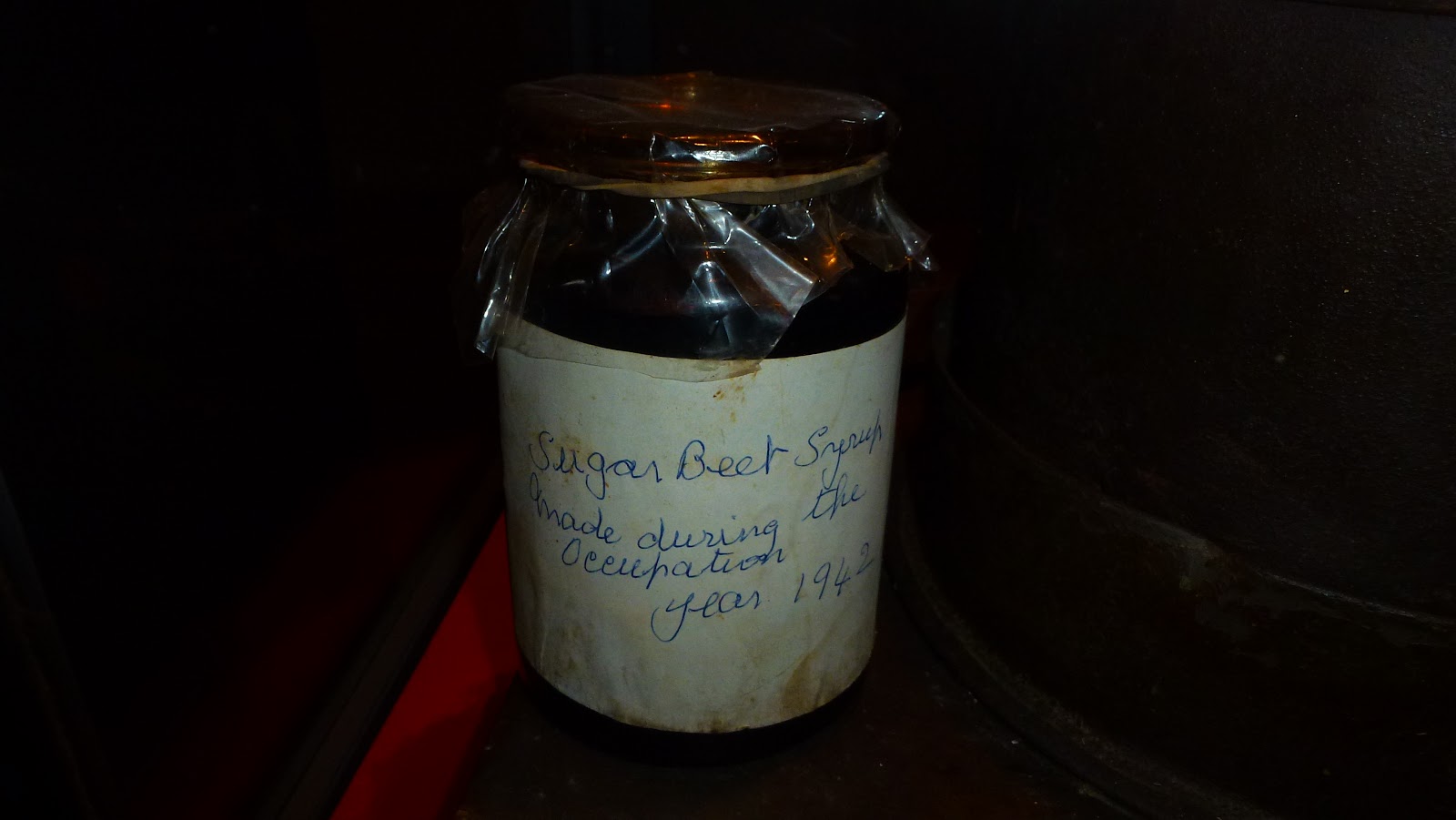
As I read through this little book, there seems to be much more than a few recipes within its 30 pages. I recall the jar of jam made in 1942 and now archived at the War Tunnels. 


A reminder of the hardships faced.


Weekend Cooking is hosted by BethFishReads

Thursday, 23 February 2012

…..A long way from home

I always think it is sad to come across a gravestone of someone who passed away many miles from home. I don’t mean those who are born in one Country and live and pass away in another, I mean those to whom death occurs and is unexpected and occurs away from home.

The point of headstones is that there is a marker to indicate that behind the name and perhaps a set of dates a person existed. It is a visual spot whereby loved ones can pay their respects and mourn.

I live in the coastal town of Teignmouth on the South Devon coast of England. I have no specific reason to visit the cemetery and no one that I know is buried there. After a few years we paid a visit to the cemetery and simply wandered around. Looking at the headstones that were erected with love and now simply a testament that someone had cared enough to place a stone, but perhaps there is no one left to visit and lay flowers.

One headstone was dedicated to a Russian mariner. Teignmouth has a working port and ships regularly dock here, both now and in the past, loading and unloading their cargo. Knowing this fact I was not surprised to see such a headstone, commemorating the passing of an individual who died many miles from home. On the few occasions I have seen the grave there are no flowers left and it suddenly occurs to me that this individual passed away 100 years ago. Perhaps there are no family left who remembers this man, perhaps his name is simply a question mark in someone’s ancestry – his existence is known, but the details surrounding his death and burial place is not.

In October 2011 my husband and I visited the Island of Jersey which lies in the seas of the British Isles and yet rather confusingly is governed completely independently of the United Kingdom. The Island lies 14 miles off the coast of France. I was looking at a map as we planned the following day’s activities. In the smallest of print I spotted the following words “W.W.2 War Graves”. The next day we headed off to our planned destination by way of a detour to the park which hosted the graves mentioned.

The board of interest indicated that the grounds were given to the people of Jersey in memory of a local land owner whose son had perished in the First World War. We then followed the path to the War Graves.

There, we felt overwhelmed. In front of us lay two groups of graves. The graves represent Servicemen who died during the Second World War. Some individuals were named, others were not. These were men whose bodies were recovered during the War and were buried within the confines of the park with the respect they deserved. They were cared for in death by the population of an Island that was inhabited from 1940 by the German Army. Yet, despite those tough times, the local population wanted those individuals to be remembered. 

As we walked along the rows of headstones, reading the names the grounds man was mowing the prestige lawn. The pattern created by the mower in uniformed strips. I stopped to talk to him and asked him about the headstones. He said rather sadly, very few people come here to see them. When I asked why, he said very simply “people forget they are here and time passes by…..”

He is right, time does pass by, but we should never forget this sacrifice. The majority of these men died many miles from home and now lie in a foreign land, some from within the UK and serving in the British Armed Services, others from the United States. Only one Grave represents Islander and that is the Grave of Maurice Jay Gould who had been born in England in 1924. His birthplace meant that he was deported from the Island at the start of the Occupation. He died in Germany aged just 19 in 1943. His body was returned to the Island in 1997 and buried in this special place.


 This post also appeared at On line Journal of Grave yard Rabbit

Tuesday, 14 February 2012

Howard Davis Park, Jersey Channel Islands WW2 Graves

P1030283P1030284P1030295P1030294P1030296P1030297
P1030298P1030299P1030300P1030301P1030302P1030303
P1030304P1030305P1030306P1030307Maurice Jay GouldMaurice Jay Gould
P1030310P1030311P1030312P1030313P1030314P1030315
Mentioned in small print on the tourist map of Jersey is the name Howard Davis Park. Alongside the name of the park is the mention of "W.W.2 War Graves". It was seeing the mention of War Graves that made us visit the park in October 2011.

In front of us lay two groups of graves. The graves represent Servicemen who died during the Second World War. Some individuals were named, others were not. These were men whose bodies were recovered during the War and were buried within the confines of the park with the respect they deserved. They were cared for in death by the population of an Island that was inhabited from 1940 by the German Army. Yet, despite those tough times, the local population wanted those individuals to be remembered. This set is the photographs of all the named graves represented.

Further photographs are HERE

Saturday, 19 November 2011

Day One - 10th October 2011 - Part Two - Maritime Museum Jersey

One of the things we did prior to returning to Jersey was to take out membership to Jersey Heritage. There were several places that we wanted to visit, and this gave our support to a valuable organisation while saving money.

The Maritime Museum is located at the Harbour. Outside the entrance there is a memorial to the Twenty Islanders who was transported and imprisoned during the German Occupation. Just inside the door there is a further set of plaques in memory of the contribution made by the Red Cross and in memory of those who perished whilst trying to escape.

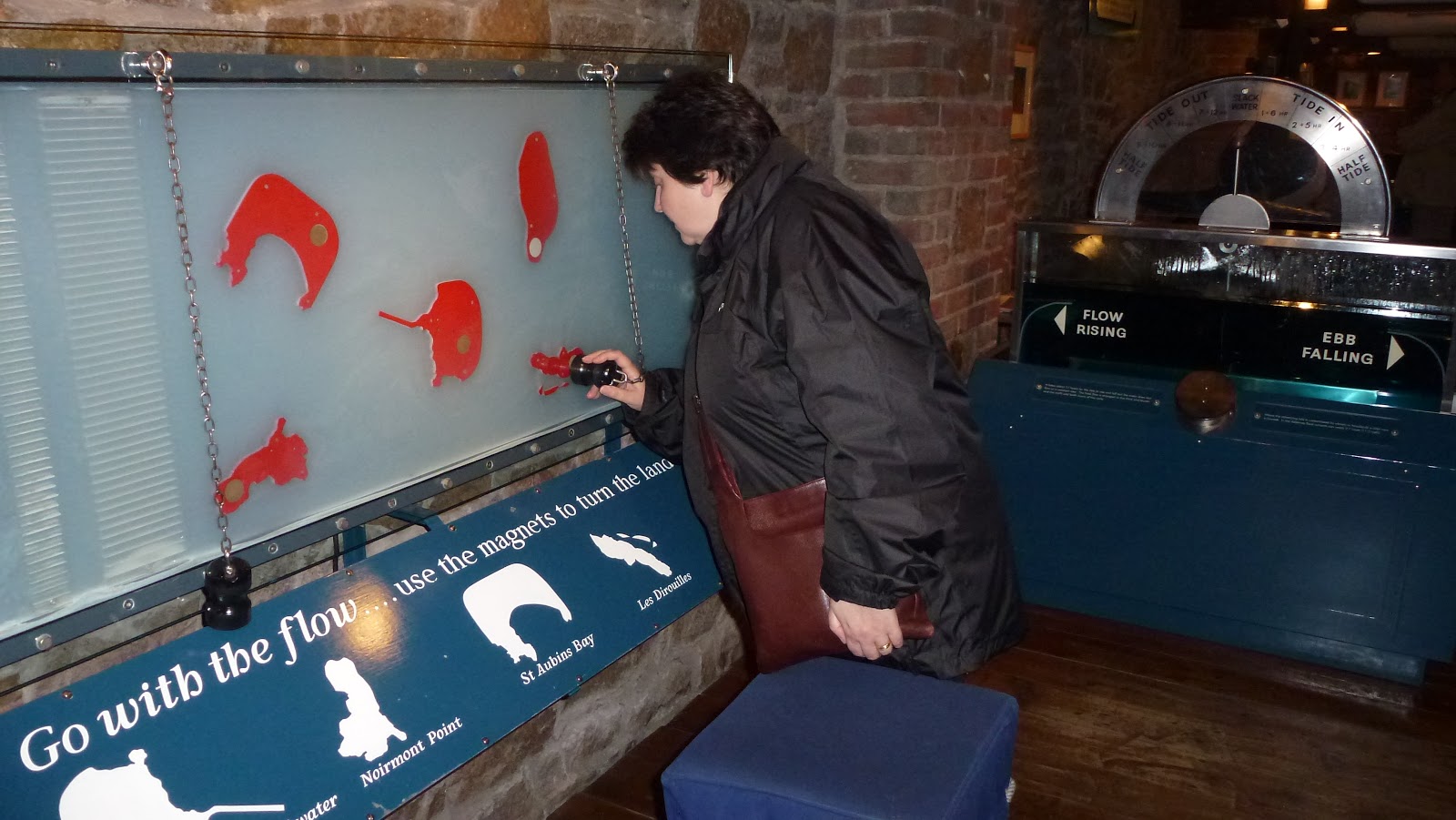
The Museum was great fun and very interactive, which would have great for children. There was lots of things you could press and experiment with, which demonstrated the various effects weather had on the sea.


Not unsurprisingly, there was quite a lot of details about ship building on the island. Then I noticed something rather interesting.....

Saturday, 22 October 2011

Weekend Cooking - Tennerfest


We recently returned from our second trip to Jersey. Boy, I love the island! As we checked into our hotel, incidentally,the same as the last trip, we were advised it was TennerFest.

So what is Tennerfest? It is an opportunity for hotels and restaurants to show off their food, premises and delights by offering a cheaper set priced menu. Initially the price was £10, but we found that those restaurants that took part offered a two course meal for £12.50 and a three course meal for £15.00.

We visited several restaurants that were taking part in the event, including The Candlelight Restaurant at the Revere Hotel where we were staying. The food was delicious and the service excellent and was in no way compromised by the cheaper price of the menu. Everything was exactly as it was when we ate there back in July.

The meal that I ate at the Revere was Leek and Potato soup for a starter, which was wonderful and a favourite of mine. Hubby had a huge bowl of mussels and everyone who walked passed the table could not resist a peek! For the main course I had a very tender Lamb Shank with onion mash potato and vegetables. Hubby had a medallion of steak with saute potato and vegetables. I missed desert, but had coffee, hubby had desert - Eton Mess with fresh berry compote. No pictures I am afraid, but it was delicious!

On the day we checked in it was my birthday. We had unpacked and headed off for the day. When we returned to our room was a wonderful surprise.


Isn't that lovely?

Linking to Weekend Cooking hosted by BethFishReads

Linkwithin

Related Posts Plugin for WordPress, Blogger...